 Image 1 of 1
Inventory is where operational decisions become financial outcomes. It absorbs uncertainty, exposes execution weakness, and quietly determines whether a system feels stable or constantly urgent. Yet most inventory discussions focus on quantities, targets, and formulas while ignoring the behavior of inventory inside real operating environments.
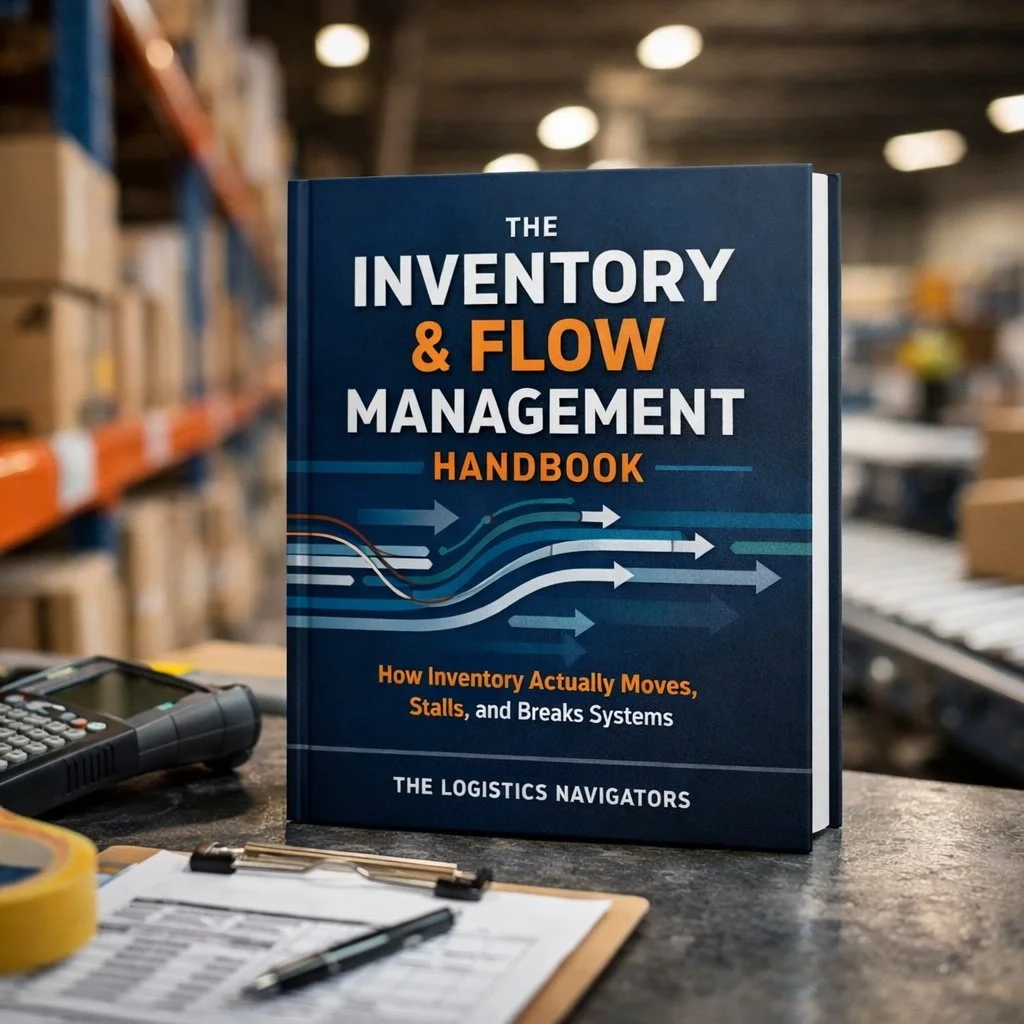
The Inventory & Flow Management Handbook is a systems-level reference designed to explain how inventory actually behaves once it enters warehouses, fulfillment centers, and multi-node networks. It is written for practitioners who are responsible for performance, not theory.
This handbook treats inventory as something that moves through time, space, and constraint. It explains why excess inventory often coexists with stockouts, why improving forecast accuracy alone rarely restores service, and why adding inventory frequently makes operations slower rather than safer. The emphasis is not on how much inventory exists, but on how inventory flows and where it stalls.
Rather than offering prescriptive formulas or generic best practices, the handbook focuses on underlying mechanics. Each concept is explored in terms of how it behaves under real conditions such as congestion, variability, labor limits, transportation delays, and processing imbalance. The goal is to build intuition around cause and effect so problems can be recognized earlier and addressed at their source.
The handbook is organized alphabetically and written in long-form entries that follow a consistent structure. Each term explains what the concept is, how it manifests operationally, how it creates downstream effects, and why it matters at the system level. This makes the handbook equally useful as a sequential read or as a diagnostic reference when something breaks in execution.
Readers will gain a deeper understanding of why inventory ages unevenly, how replenishment lag creates artificial shortages, why buffers grow without improving service, and how flow constraints quietly dictate inventory outcomes. The material connects inventory behavior to warehouse throughput, transportation reliability, and planning discipline without relying on vendor tools or specific methodologies.
This handbook is intentionally vendor-neutral and software-agnostic. It does not assume a particular WMS, ERP, or planning platform. The principles apply whether you are operating a single warehouse or a distributed network, managing consumer goods or industrial materials, or supporting e-commerce, retail, or B2B fulfillment.
The Inventory & Flow Management Handbook is designed for operations managers, supply chain leaders, planners, founders, and investors who need to understand why inventory behaves the way it does under pressure. It is particularly valuable for those who find themselves reacting to the same problems repeatedly despite adding inventory, labor, or system complexity.
Used correctly, this handbook becomes a reference for diagnosing root causes, evaluating tradeoffs, and designing systems that rely less on buffer accumulation and more on flow stability. Its value compounds over time as patterns become easier to recognize and interventions become more deliberate.
Inventory will always exist. Variability will always be present. But when inventory is understood as a dynamic system rather than a static asset, it becomes governable. This handbook exists to support that shift in understanding.